Introduction
Choosing the right blogging platform can make or break your online success. With countless options available today, content creators face a critical decision: should you go with an established powerhouse or explore newer alternatives that promise streamlined experiences?
BlogHyper and WordPress represent two distinct approaches to blogging. While WordPress powers 43.6% of all websites globally and dominates with 61% of the CMS market, BlogHyper offers a fresh perspective focused on blogging optimization and community-driven growth. Understanding the differences between these platforms helps you make an informed choice based on your specific needs, technical skills, and long-term goals.
In this comprehensive comparison, you’ll discover how each platform handles content creation, customization, SEO, community features, and scalability. Whether you’re launching your first blog or considering a platform migration, this guide provides the clarity you need to choose wisely.
Understanding BlogHyper: The Modern Blogging Approach
BlogHyper represents a contemporary take on blogging that emphasizes optimization, clarity, and community support. Rather than overwhelming users with endless features, the platform focuses on helping creators publish better content with streamlined workflows.
BlogHyper blends creativity with optimization, encouraging users to concentrate on clarity while providing structured approaches to writing. This makes it particularly attractive for beginners who struggle with structure, tone, and keyword placement, though experienced creators also appreciate the simplified workflow.
The BlogHyper Philosophy
The core principle behind BlogHyper centers on quality over quantity. The platform guides users toward creating content that aligns with modern SEO principles without falling into the trap of over-optimization. This balance proves crucial as search engines increasingly prioritize genuine value and reader experience.
BlogHyper serves dual purposes effectively—supporting casual bloggers exploring their interests while providing professional content marketers with tools for serious growth. This adaptability across different writing styles explains why the platform gains traction within digital communities.
Understanding WordPress: The Industry Standard
WordPress began in 2003 as a blogging platform and has since powered over 518 million websites, evolving from simple blog software into a comprehensive content management system. Today, it supports everything from personal blogs to enterprise websites, online stores, and complex web applications.
The platform’s open-source nature means thousands of developers worldwide contribute to its improvement. This collaborative approach has created an ecosystem featuring over 60,000 free plugins and 13,000 themes, offering virtually unlimited customization possibilities.
WordPress Market Dominance
The numbers tell a compelling story. WordPress’s market share grew from 21% in 2014 to 43.6% in 2026, doubling its user base within a decade. Major organizations, including Sony, The White House, Vogue, and BBC America, rely on WordPress, demonstrating its enterprise-grade capabilities.
Over 70 million new posts and 77 million comments are published monthly across WordPress sites, highlighting the platform’s role in powering active publishing environments worldwide.
Key Differences: BlogHyper vs WordPress
Platform Type and Architecture
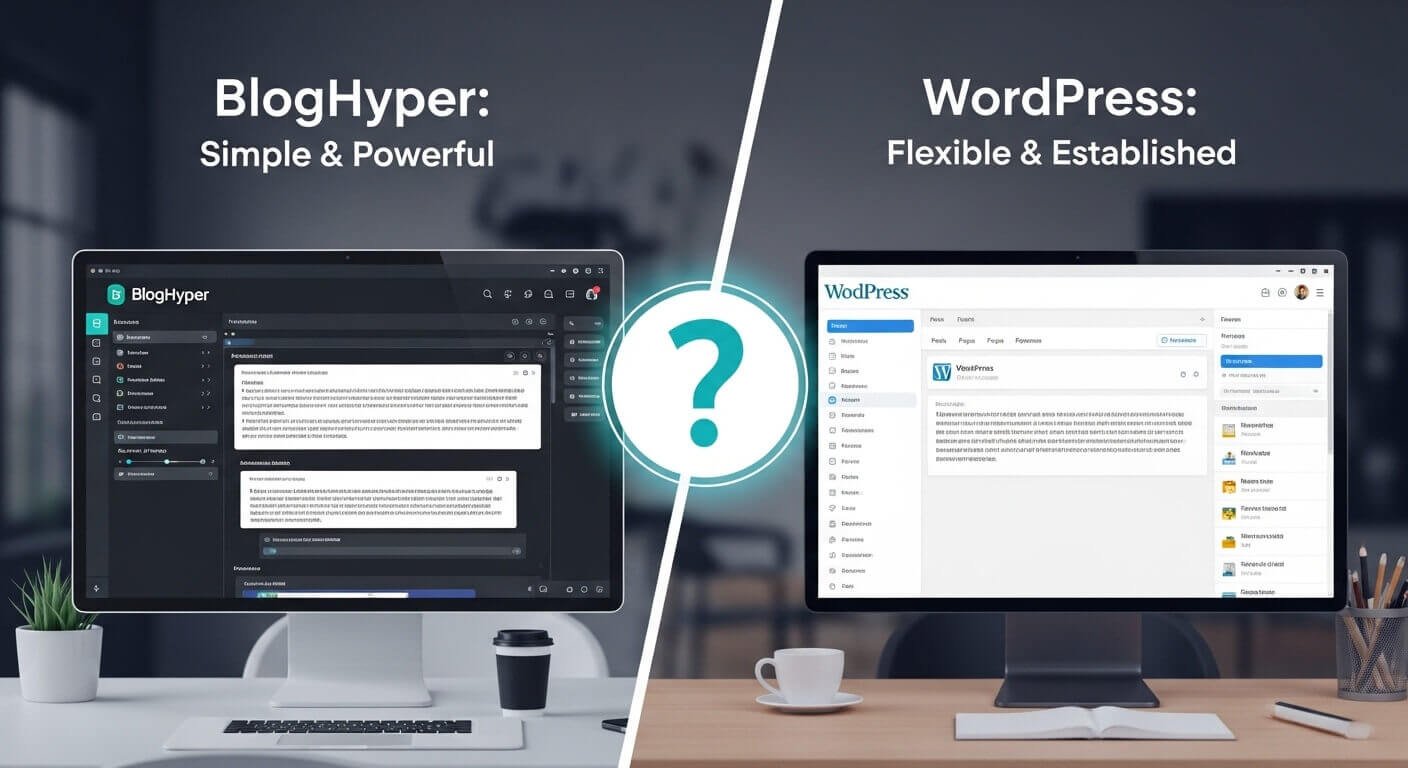
WordPress functions as a complete content management system requiring hosting, domain setup, and technical configuration. You download the software, install it on your server, and maintain full control over your website infrastructure.
BlogHyper takes a different approach by focusing on blogging methodology and optimization strategies rather than providing hosting infrastructure. It emphasizes the content creation process itself, offering guidance and community support rather than technical backend management.
Ease of Use and Learning Curve
For absolute beginners, BlogHyper offers advantages through its focused, streamlined approach. The platform removes decision paralysis by concentrating on essential blogging elements, helping newcomers start creating without overwhelming technical choices.
WordPress presents a steeper initial learning curve due to its extensive capabilities. New users face decisions about themes, plugins, hosting providers, and configuration settings. However, once familiar with the basics, WordPress becomes increasingly intuitive, especially with modern block editors and improved interfaces.
Customization and Flexibility
WordPress excels in customization potential. The combination of themes, plugins, and custom code allows virtually any design or functionality imaginable. Need an online store? Install WooCommerce. Want membership features? Add a membership plugin. This flexibility explains why WordPress powers everything from simple blogs to complex enterprise solutions.
BlogHyper focuses customization efforts on content optimization rather than design flexibility. The platform prioritizes helping users refine their writing process, improve SEO naturally, and build engaged audiences through quality content strategies.
Content Creation Experience
BlogHyper emphasizes clarity and structure in content creation. The platform guides writers through best practices, encouraging natural keyword usage and reader-focused writing. This approach helps creators avoid accidentally over-optimizing content while ensuring necessary terms appear at appropriate frequencies.
WordPress offers powerful content creation through its Gutenberg block editor, allowing drag-and-drop page building and extensive formatting options. The Gutenberg editor boasts over 82.7 million active installations, with users creating over 264.3 million posts using it in recent years. This demonstrates widespread adoption of WordPress’s modern content creation tools.
SEO Capabilities Compared
BlogHyper’s SEO Approach
BlogHyper built its reputation on helping bloggers improve search rankings through natural optimization. The platform teaches proper keyword integration, content structure, and readability optimization without encouraging manipulative tactics. This educational approach helps users develop sustainable SEO skills that transfer across platforms.
The community aspect reinforces good SEO practices through shared experiences and peer feedback, creating an environment where bloggers learn from each other’s successes and mistakes.
WordPress SEO Power
WordPress’s Yoast SEO plugin has over 10 million active installations and 700+ million lifetime downloads, making it the dominant SEO tool in the ecosystem. Combined with other SEO plugins, WordPress offers comprehensive optimization capabilities.
WordPress sites benefit from clean code structure, fast loading capabilities (when properly configured), mobile responsiveness, and schema markup support—all crucial ranking factors. Among the top 1 million high-traffic sites, 29.13% use WordPress, demonstrating its effectiveness for achieving significant search visibility.
Community and Support
BlogHyper Community Features
BlogHyper emphasizes community-driven growth and peer support. Bloggers trust other bloggers, and word-of-mouth promotion within the BlogHyper community drives its increasing popularity. This social proof creates an environment where members actively share experiences and recommendations.
The platform fosters collaboration through shared learning, making it valuable for creators who benefit from structured guidance and community accountability.
WordPress Global Community
Over 1,200 WordCamps have been held in 395 cities across 65 countries, with 100,000+ contributors actively improving WordPress worldwide. This massive community provides unmatched resources, including forums, documentation, tutorials, and local meetup groups.
The WordPress community’s size means virtually any question has been answered somewhere, and abundant learning resources exist for every skill level. However, this abundance can feel overwhelming when searching for specific solutions.
Cost Considerations
BlogHyper Pricing
BlogHyper operates primarily as a community and resource platform, focusing on providing tips, tools, and supportive environments for bloggers. Specific pricing structures vary based on membership levels and premium features offered.
The platform allows users to implement learned strategies on any blogging platform, meaning you’re investing in knowledge and methodology rather than hosting infrastructure.
WordPress Cost Structure
WordPress software itself is free and open-source. However, running a WordPress site involves several costs:
- Hosting: Ranges from $3-$50+ monthly, depending on traffic and performance needs
- Domain name: Typically $10-$15 annually
- Premium themes: $30-$100+ one-time or annual fees
- Premium plugins: Variable pricing, often $50-$200+ annually
- Maintenance and security: Potential ongoing costs for updates and protection
Total costs vary dramatically based on your requirements. A basic blog might cost $50-$100 annually, while professional sites with premium features could reach thousands yearly.
Performance and Speed
WordPress performance depends heavily on hosting quality, theme efficiency, plugin choices, and optimization efforts. Studies indicate that websites optimized for mobile devices typically load in less than three seconds, crucial because 53% of mobile users leave websites taking longer.
Properly configured WordPress sites achieve excellent speed through caching plugins, content delivery networks, image optimization, and quality hosting. However, poor configurations or excessive plugins can significantly slow performance.
BlogHyper’s performance impact relates more to content quality and optimization methodology rather than technical infrastructure, since it focuses on blogging practices rather than hosting.
Security Considerations
WordPress security statistics reveal that sites are attacked every 22 minutes, with 13,000 WordPress sites hacked daily. However, 92% of breaches stem from outdated plugins, meaning regular updates and security best practices dramatically reduce risks.
WordPress offers robust security through dedicated plugins like Wordfence and Sucuri, two-factor authentication, regular updates, and security-focused hosting. The platform’s popularity makes it a target, but also ensures rapid security patch deployment.
BlogHyper’s security concerns differ since it doesn’t host your content directly. Security depends on where you publish content using BlogHyper strategies.
Scalability and Growth Potential
WordPress scales from personal blogs to enterprise solutions, handling millions of visitors. Major corporations, including Sony, Disney, and Vogue, rely on WordPress, demonstrating its enterprise capabilities. The platform handles growth through better hosting, caching, and optimization strategies.
BlogHyper’s scalability relates to skill development and community growth rather than technical infrastructure. As your blogging expertise increases, the platform’s strategies and community continue providing value regardless of where you ultimately host content.
E-commerce Capabilities
WooCommerce leads the global e-commerce platform market with a 33.07% share, powering around 120 million websites. This makes WordPress, through WooCommerce, an extremely powerful e-commerce solution offering complete control over online stores.
WordPress e-commerce capabilities include inventory management, payment processing, shipping integration, and extensive customization options. Many successful online businesses run entirely on WordPress with WooCommerce.
BlogHyper doesn’t directly compete in e-commerce functionality, focusing instead on content creation and blog optimization strategies.
Mobile Responsiveness
Over 90% of WordPress themes available in official repositories now come with responsive design as a standard feature. Modern WordPress automatically adapts to different screen sizes, ensuring good mobile experiences.
Mobile optimization in BlogHyper relates to content creation practices that work well across devices—short paragraphs, clear formatting, and readable structure that enhances mobile user experience.
Best Use Cases for Each Platform
Choose BlogHyper If You:
- Want focused guidance on blogging best practices without technical complexity
- Value community support and peer learning over technical customization
- Prefer streamlined workflows that emphasize content quality
- Seek education on modern SEO principles and optimization strategies
- Plan to publish on various platforms using a consistent methodology
- Appreciate structured approaches to content creation
Choose WordPress If You:
- Need a complete website solution with full control over design and functionality
- Want extensive customization through themes and plugins
- Plan to scale from a blog to a full business website or online store
- Have technical skills or willingness to learn web development basics
- Require specific features like membership systems, forums, or e-commerce
- Value platform independence and complete ownership of your site
Migration Considerations
Switching between platforms requires careful planning. Moving from BlogHyper strategies to WordPress implementation is straightforward since BlogHyper focuses on content methodology rather than hosting infrastructure. You simply apply learned principles to your WordPress site.
Migrating away from WordPress to another platform proves more complex due to content volume, custom features, and technical dependencies. However, WordPress’s export tools facilitate moving content to other systems when necessary.
Making Your Decision
Consider these key factors when choosing:
- Technical Comfort Level: WordPress requires more technical knowledge, while BlogHyper emphasizes content skills over technical expertise.
- Long-term Goals: If you envision expanding beyond blogging into e-commerce, memberships, or complex functionality, WordPress provides the necessary infrastructure. For pure content focus, BlogHyper’s methodology-driven approach may suffice.
- Budget: WordPress involves ongoing hosting and potentially premium theme/plugin costs. BlogHyper operates differently, focusing on community access and learning resources.
- Time Investment: WordPress demands more initial setup and ongoing maintenance time. BlogHyper allows a faster start to content creation with less technical overhead.
- Control Needs: WordPress offers complete control over every aspect of your site. BlogHyper provides structured guidance within its methodology.
Conclusion
BlogHyper and WordPress serve different but complementary roles in the blogging ecosystem. WordPress stands as the proven, versatile platform powering nearly half the web, offering unlimited possibilities through its extensive ecosystem. Its dominance stems from genuine capability—the flexibility to create virtually any website type combined with strong community support.
BlogHyper offers valuable methodology and community for bloggers seeking focused guidance on creating optimized, reader-friendly content. Its strength lies in simplifying the blogging process and teaching sustainable practices rather than providing technical infrastructure.
For many creators, these platforms aren’t mutually exclusive. You might use BlogHyper’s community and strategies while building your site on WordPress, combining the best of both approaches. Alternatively, choose based on whether you prioritize technical flexibility (WordPress) or streamlined content focus (BlogHyper).
Evaluate your specific needs, technical comfort, budget, and goals. Both platforms have proven track records helping bloggers succeed—your choice depends on which approach aligns better with your vision and working style.
Frequently Asked Questions
Can I use BlogHyper strategies on a WordPress website?
Absolutely. BlogHyper focuses on content creation methodology and optimization strategies that apply to any blogging platform, including WordPress. Many bloggers successfully combine BlogHyper’s community guidance and best practices with WordPress’s technical capabilities. This combination leverages WordPress’s powerful infrastructure while benefiting from BlogHyper’s content optimization approaches and community support. The strategies you learn through BlogHyper—including natural SEO, reader engagement, and content structure—transfer seamlessly to WordPress or any other platform you choose.
Is WordPress suitable for complete beginners with no technical experience?
Yes, though expect a learning curve. Modern WordPress has become significantly more user-friendly, especially with the Gutenberg block editor that simplifies page building through drag-and-drop functionality. Many hosting providers offer one-click WordPress installation and beginner-friendly dashboards. Abundant tutorials, documentation, and community support help newcomers learn. However, you’ll need patience to understand themes, plugins, and basic site management. If technical aspects feel overwhelming, consider managed WordPress hosting where providers handle technical details, allowing you to focus primarily on content creation.
Which platform is better for SEO and search engine rankings?
Both approaches support strong SEO, but differently. WordPress provides powerful SEO capabilities through plugins like Yoast SEO, which has over 10 million active installations. The platform offers complete control over technical SEO elements, including meta tags, schema markup, site speed optimization, and mobile responsiveness. BlogHyper excels at teaching natural SEO practices and content optimization methodology that creates genuinely valuable content—increasingly important as search engines prioritize user experience. Ideal approach: use WordPress for technical SEO infrastructure while applying BlogHyper’s content optimization principles. This combination addresses both technical and content aspects of search rankings effectively.
What are the ongoing costs for running a WordPress website?
WordPress costs vary based on your needs. Basic blogs might cost $50-$100 annually for hosting and domain registration. Professional sites typically spend $200-$500 yearly, including premium themes and essential plugins. E-commerce or high-traffic sites could reach $1,000-$3,000+ annually for quality hosting, premium plugins, security, and maintenance. WordPress software itself is free; costs come from hosting, domain, optional premium themes/plugins, and potentially developer assistance for customization. Budget-conscious bloggers can start inexpensively with shared hosting and free themes, upgrading as their site grows and generates revenue.
Can I switch from BlogHyper to WordPress or vice versa later?
Switching is possible but varies in complexity. Moving from BlogHyper’s methodology to WordPress implementation is straightforward since BlogHyper focuses on content practices rather than hosting. You simply apply learned principles to WordPress. Migrating from WordPress to another platform requires more effort due to content volume, plugins, and customizations. WordPress provides export tools that simplify moving content, but recreating custom features and designs takes time. Consider starting with the platform that best matches your current needs rather than choosing based solely on potential future changes. Most successful bloggers stay with their chosen platform long-term once properly established.
Does WordPress require coding knowledge?
Not necessarily. You can create and manage WordPress sites without writing code using themes, page builders like Elementor, and plugins for desired functionality. The Gutenberg editor enables sophisticated page layouts through visual drag-and-drop. However, coding knowledge (HTML, CSS, and PHP) provides advantages for advanced customization, troubleshooting, and creating unique designs. Many successful WordPress users never touch code, relying on premium themes and plugins instead. As your needs grow, basic coding skills become increasingly valuable but remain optional for standard blogging and content publishing.
Which platform offers better monetization opportunities?
WordPress provides more direct monetization infrastructure through plugins and integrations. You can easily add advertising networks, implement affiliate marketing, sell digital products, create membership sites, or launch full e-commerce stores with WooCommerce. Complete control over your site means keeping all revenue minus hosting and tool costs. BlogHyper’s monetization relates more to developing skills and audiences that translate into income regardless of platform. The community might guide monetization strategies, but implementation occurs on whatever platform hosts your content. For maximum monetization flexibility and control, WordPress offers more built-in capabilities and tools.