Introduction: Why Every Driver Needs to Know This Essential Skill
Picture this: You’re driving home after a long day, and suddenly you hear that dreaded thump-thump-thump sound. Your heart sinks as you realize you have a flat tire. What do you do?
If you’re like millions of drivers, you might reach for your phone to call roadside assistance. But what if you’re in an area with no cell service? Or during a snowstorm when help could take hours to arrive? This is exactly why knowing how to change a tire yourself isn’t just convenient—it’s essential.
According to AAA, they respond to over 4 million flat tire calls every year in the United States alone. That’s one call every 8 seconds. While professional help is wonderful, the reality is that changing a tire is a fundamental skill every licensed driver should master. The good news? It’s far easier than you think.
In this comprehensive guide, you’ll learn the complete process of changing a tire from start to finish. We’ll cover everything from the tools you need to safety precautions, common mistakes to avoid, and expert tips that even experienced mechanics swear by. By the end, you’ll have the confidence to handle this roadside emergency like a pro.
What Is a Flat Tire and When Do You Need to Change It?
Understanding Tire Damage
A flat tire occurs when air escapes from your tire, leaving it unable to support your vehicle’s weight properly. This can happen for several reasons: sharp objects like nails or glass puncturing the rubber, hitting a pothole at high speed, gradual air leaks from valve stem damage, or simply from normal wear and tear over time.
Not every tire issue requires an immediate roadside change. Sometimes you might notice your tire is slowly losing air, which gives you time to drive to a repair shop. However, if you experience a sudden blowout or a complete flat while driving, you’ll need to change it right away.
Signs You Have a Flat Tire
Your vehicle will tell you when something’s wrong. Common signs include pulling to one side while driving, a thumping noise from one of your wheels, visible sagging on one corner of the car, or your tire pressure warning light illuminating on your dashboard. If you notice any of these symptoms, find a safe place to pull over and inspect your tires immediately.
Essential Tools and Equipment: What You Need Before Starting
The Core Toolkit
Before you attempt to change a tire, you need to gather the right equipment. Fortunately, most vehicles come with the basic tools already stored in your trunk or under your cargo floor. Here’s what you’ll need:
- Spare Tire – This is your replacement tire. Most modern cars come with either a full-size spare (identical to your regular tires) or a donut spare (a smaller, temporary tire). Check your spare’s air pressure regularly—experts recommend 60 PSI for donut spares. A flat spare tire is useless when you need it most.
- Car Jack – This hydraulic or mechanical device lifts your vehicle off the ground. Your owner’s manual shows exactly where to position it. Never use a jack on soft ground like mud or sand, as it could sink and cause your vehicle to fall.
- Lug Wrench – Also called a tire iron, this tool removes and tightens the lug nuts that hold your wheel in place. Most vehicles include a cross-shaped or L-shaped wrench. The cross-shaped version gives you better leverage.
- Wheel Wedges – These blocks prevent your car from rolling while jacked up. If you don’t have proper wedges, you can use bricks or large rocks as substitutes.
Optional But Helpful Items
While not necessary, these items make the job easier and safer: work gloves to protect your hands, a flashlight for nighttime emergencies, a rain poncho if the weather is poor, and a piece of wood to place under your jack on soft surfaces for stability.
Safety First: Critical Precautions Before You Start
Finding a Safe Location
The moment you realize you have a flat tire, your priority is finding the safest possible spot to pull over. This is arguably the most important decision you’ll make during the entire process.
On highways, try to exit completely and find a parking lot. If that’s not possible, pull onto the shoulder as far right as you can get, away from traffic lanes. Never stop in a travel lane or on a curve where other drivers can’t see you clearly. On regular streets, look for a flat, paved area away from moving vehicles.
Securing Your Vehicle
Once you’ve found your safe spot, take these critical safety steps before touching any tools. First, turn on your hazard lights—this alerts other drivers that you’re stopped and vulnerable. Apply your parking brake firmly to prevent any rolling. If you’re on a hill, turn your wheels toward the curb as an additional precaution.
Next, place wheel wedges behind the tires opposite the flat. If your front-left tire is flat, wedge your rear-right tire. This creates a diagonal brace that prevents rolling. If you have passengers, it’s actually safer for them to wait outside the vehicle, away from traffic, rather than sitting inside where they could be injured if another vehicle strikes you.
Understanding the Risks
According to the National Highway Traffic Safety Administration, roadside accidents injure thousands of people each year. Many of these injuries happen to people changing tires on busy roads. If you feel unsafe at any point—heavy traffic, unstable ground, or poor visibility—it’s better to call for professional help than risk your wellbeing.
Step-by-Step Guide: How to Change a Tire the Right Way
Step 1: Locate and Prepare Your Tools
Open your trunk and find your spare tire, jack, and lug wrench. These are typically stored under the trunk floor mat or in a side compartment. In SUVs and trucks, the spare might be mounted underneath the vehicle or on the back door. Consult your owner’s manual if you’re unsure.
Check your spare tire by pressing on it firmly—it should feel hard and fully inflated. A soft spare tire won’t support your vehicle and could be dangerous to drive on.
Step 2: Loosen the Lug Nuts (But Don’t Remove Them Yet)
This step is crucial and often done incorrectly. Before lifting your car with the jack, you need to loosen the lug nuts while the tire is still on the ground. Why? Because once the tire is off the ground, it will simply spin when you try to turn the lug nuts.
First, remove the hubcap or wheel cover if your vehicle has one. Some pop off easily, while others require the flat end of your lug wrench to pry them off gently.
Now position your lug wrench on one lug nut and push down counterclockwise. Remember the phrase “lefty loosey, righty tighty.” You may need to use your body weight—place the wrench horizontally and step on it if necessary. The lug nuts should break free with a firm push, but don’t unscrew them completely. Just loosen each one about a half turn.
Work on all the lug nuts in this step. Most cars have either four, five, or six lug nuts per wheel.
Step 3: Position the Jack Correctly
This is where many people make dangerous mistakes. Your vehicle has specific jack points—reinforced metal areas designed to handle the jack’s pressure. Using the wrong spot can damage your vehicle or cause it to fall.
Look underneath your car near the flat tire. You’ll see a small notch or tab on the metal frame. This is your jack point. Your owner’s manual will show you exactly where these points are located for your specific vehicle.
Place the jack under this point, making sure it sits on solid, level ground. If you’re on soft dirt or asphalt, place a small piece of wood under the jack’s base to distribute the weight and prevent sinking.
Step 4: Raise Your Vehicle Off the Ground
Begin cranking or pumping your jack slowly and steadily. Watch carefully to ensure the jack remains stable and perpendicular to the ground as the vehicle rises. If it starts to lean or slip, lower the vehicle immediately and reposition.
Raise the vehicle until the flat tire is about six inches off the ground. This gives you enough clearance to remove the flat tire and install the spare, which may be slightly larger.
Critical Safety Warning: Never, under any circumstances, place any part of your body under a vehicle supported only by a jack. Jacks can fail, and thousands of pounds could come crashing down in an instant.
Step 5: Remove the Lug Nuts and Flat Tire
Now that the weight is off the tire, you can unscrew the lug nuts completely. Turn them counterclockwise until they come free. Place them somewhere safe—inside the hubcap is a good spot, so they don’t roll away.
Grip the tire by the treads (the grooved rubber part) with both hands. Pull it straight toward you. It should slide right off the wheel studs. Flat tires can be heavy, especially on larger vehicles, so bend your knees and lift with your legs, not your back.
Set the flat tire aside, laying it flat so it doesn’t roll away.
Step 6: Mount the Spare Tire
Pick up your spare tire and align the hole in the center with the hub in the middle of the wheel studs. This can be the trickiest part for beginners because you’re holding a heavy tire while trying to line up multiple holes simultaneously.
Here’s a pro tip: Once you get the top stud through its hole, you can rest the tire’s weight on that stud while you align the others. Push the tire onto the hub until all the wheel studs poke through the tire’s holes evenly.
Step 7: Hand-Tighten the Lug Nuts
Thread the lug nuts back onto the wheel studs by hand. Turn them clockwise, tightening them as much as you can with just your fingers. This step is important because it ensures the lug nuts are threaded correctly and not cross-threaded, which could damage the studs.
Don’t use the wrench yet—you’ll do that in the next step. Just get them snug by hand.
Step 8: Lower the Vehicle Partially
Using your jack, lower the vehicle slowly until the spare tire just touches the ground, but isn’t bearing the full weight yet. The tire should be making contact but not compressed.
This position stabilizes the tire, so it won’t spin when you tighten the lug nuts with the wrench.
Step 9: Tighten Lug Nuts in a Star Pattern
Now comes the critical tightening step. This isn’t just about making them tight—it’s about tightening them in the correct sequence.
If you have five lug nuts, imagine them as points on a star. Tighten one, then skip to the one across from it (not the one next to it). This creates a star pattern. For a five-lug wheel, the pattern would be: top, bottom-left, middle-right, middle-left, bottom-right.
If you have four lug nuts, tighten them in a criss-cross pattern: top, then bottom, then left, then right.
Why does this matter? This pattern ensures even pressure distribution across the wheel. If you tighten them in a circle (one after another), you could warp your brake rotor or leave one side of the wheel loose.
Turn each lug nut clockwise as tightly as you can with the wrench. Use your body weight if needed. They should be very tight—you’re tightening them against thousands of pounds of force when driving.
Step 10: Lower the Vehicle Completely and Final Tightening
Now, lower your vehicle all the way to the ground and remove the jack completely. Give each lug nut one more firm tightening in the same star pattern. With the vehicle’s full weight on the tire, you can achieve maximum tightness.
Some mechanics recommend tightening lug nuts to a specific torque specification (usually 80-100 foot-pounds for most cars), which requires a torque wrench. While this is ideal, it’s not necessary for emergency roadside changes. Just make them as tight as you reasonably can.
Replace your hubcap if you removed one earlier. Some hubcaps have a specific orientation for the valve stem, so check that it aligns correctly.
Step 11: Store Your Equipment and Check Everything
Place your flat tire, jack, and lug wrench back in their storage locations. Don’t leave the flat tire on the side of the road—it’s illegal in most areas and harmful to the environment.
Before driving away, do a final walk-around inspection. Check that all lug nuts are tight, your tools are stored, and nothing is left on the ground.
After the Change: Critical Next Steps You Can’t Skip
Drive to a Tire Shop Immediately
Your spare tire is designed for temporary use only. Even full-size spares aren’t meant for extended driving. Donut spares (space-savers) have strict limitations: maximum speed of 50 mph and maximum distance of 50-70 miles.
Drive directly to the nearest tire repair shop or automotive service center. Most tire punctures can be repaired for $15-30 if caught early. A patch or plug takes about 20 minutes and is far cheaper than a new tire.
Have Your Flat Tire Inspected
When you arrive at the shop, ask the technician to inspect your flat tire. Sometimes the damage is repairable, which saves you money. However, if the puncture is in the sidewall, larger than a quarter inch, or if the tire is old or worn, you’ll need a replacement.
Tire professionals follow strict safety guidelines about what can and can’t be repaired. Trust their judgment—a tire failure at highway speeds can be catastrophic.
Check Your Lug Nut Tightness
After driving 25-50 miles on your newly installed spare or repaired tire, stop and recheck your lug nuts with your wrench. Vibration from driving can sometimes cause them to loosen slightly. This quick five-minute check could prevent your wheel from coming off while driving.
Common Mistakes to Avoid When Changing a Tire
Mistake 1: Changing a Tire in a Dangerous Location
We mentioned this earlier, but it bears repeating: location is everything. Don’t attempt a tire change on a blind curve, in an active traffic lane, or on extremely soft ground. If you can’t find a safe spot, it’s better to drive slowly on your flat tire to reach safety (even if it damages your rim) than to risk being hit by another vehicle.
Mistake 2: Not Loosening Lug Nuts Before Jacking
This is the most common mistake beginners make. If you jack up your car first, the wheel will spin freely when you try to loosen the lug nuts, making it nearly impossible to remove them. Always loosen lug nuts while the tire is still on the ground.
Mistake 3: Using the Wrong Jack Point
Modern cars have plastic body panels and undercarriage covers that look sturdy but will crack or collapse under a jack’s pressure. Always use the designated jack points shown in your owner’s manual. Damage from improper jacking isn’t covered by most warranties.
Mistake 4: Tightening Lug Nuts in a Circle
Tightening lug nuts sequentially (one right after another in a circle) creates uneven pressure. This can warp your brake rotor, cause vibration while driving, or even allow the wheel to work loose. Always use the star or criss-cross pattern.
Mistake 5: Forgetting About Your Spare Tire
Most drivers never check their spare until they need it—and that’s when they discover it’s completely flat. Check your spare tire’s air pressure every six months during your routine maintenance. A flat spare is useless in an emergency.
Mistake 6: Driving Too Far on a Donut Spare
Donut spares are compact and lightweight because they’re designed for temporary use only. They have thinner tread, lighter construction, and can’t handle the stresses of normal driving. Exceeding 50 mph or driving more than 70 miles risks a blowout or damage to your vehicle’s differential.
Pro Tips from Automotive Experts
Practice in Your Driveway
Don’t wait for a roadside emergency to change your first tire. Spend 30 minutes one weekend afternoon practicing in your driveway or garage. You’ll familiarize yourself with your tools, find your jack points, and build muscle memory. When an actual emergency happens, you’ll work confidently and quickly instead of fumbling in stress and darkness.
Keep Your Spare Properly Inflated
Mark your calendar to check your spare tire pressure every six months. Most donut spares require 60 PSI—much higher than your regular tires. A properly inflated spare can mean the difference between getting home safely and being stranded.
Upgrade Your Emergency Kit
Your vehicle’s included tools meet minimum standards, but upgrading a few items can make the job significantly easier. A hydraulic floor jack is more stable than a scissor jack. A four-way lug wrench gives you better leverage than the standard L-shaped one. LED road flares are more visible and safer than old-style flares.
Know Your Limitations
Some situations require professional help. If you have a flat tire on a steep hill, in heavy traffic, during severe weather, or if you have physical limitations that prevent you from safely performing the work, calling for assistance is the smart choice. There’s no shame in prioritizing your safety.
Take Photos for Reference
When you practice changing your tire, take photos of each step, especially the jack points and lug nut pattern for your specific vehicle. Store these photos in your phone. During an actual emergency, especially at night or in stressful conditions, having visual references can be invaluable.
What to Do If You Don’t Have a Spare Tire
The Modern Reality
Many newer vehicles, especially compact cars and electric vehicles, no longer include spare tires. Manufacturers eliminate them to save weight, improve fuel efficiency, and create more cargo space. Instead, they often include tire repair kits or run-flat tires.
Tire Repair Kits
These kits typically contain a can of tire sealant and a portable air compressor. To use one, you remove the object that caused the puncture (if it’s still in the tire), inject the sealant through the valve stem, and then inflate the tire using the compressor.
This solution works for small punctures in the tread area but won’t help with sidewall damage, large holes, or complete blowouts. The sealant is also temporary—you still need to drive to a tire shop for proper repair.
Run-Flat Tires
Run-flat tires have reinforced sidewalls that support the vehicle even when the tire is completely deflated. They allow you to drive up to 50 miles at speeds up to 50 mph after a puncture.
The downside? Run-flat tires are expensive to replace, provide a harsher ride, and once they’ve been driven while flat, they must be replaced regardless of whether the puncture itself is repairable.
Roadside Assistance Options
If your vehicle lacks a spare tire, consider subscribing to a roadside assistance program. AAA memberships start around $60 annually. Many car manufacturers include free roadside assistance for the first few years of ownership. Your auto insurance might also offer roadside assistance as an add-on for $10-20 per year.
Special Situations: Handling Unique Tire Change Challenges
Changing a Tire at Night
Nighttime tire changes present extra challenges. Visibility is reduced, making it harder to see approaching traffic, find your jack points, and inspect your work. If you must change a tire after dark, use your car’s hazard lights, turn on your interior lights, and use a flashlight or smartphone light to illuminate your work area.
Consider purchasing LED road flares or reflective emergency triangles. Place them 10-20 feet behind your vehicle to warn approaching drivers. These devices are visible from over 1,000 feet away and significantly reduce your risk of being struck.
Dealing with Stuck or Rusted Lug Nuts
In areas with harsh winters where road salt is common, lug nuts can rust and become extremely difficult to remove. If you can’t budge a lug nut with your body weight on the wrench, stop before you strip the nut or break your tool.
Try penetrating oil (like WD-40) sprayed on the threads, then wait a few minutes before trying again. If that doesn’t work, you may need to call for professional help. Tow truck drivers carry impact wrenches that can remove even the most stubborn lug nuts.
Changing a Tire on a Slope
Ideally, you should never change a tire on a slope, but sometimes you have no choice. If you must, take extra precautions. Position your vehicle so the slope runs from front to back (not side to side). Use wheel wedges on both sides of the tire, diagonal to the flat. Have a passenger stay in the vehicle to apply the brake if needed, or place the transmission in first gear (manual) or park (automatic) with the parking brake fully engaged.
Consider placing large rocks or additional wedges for extra security. If the slope is steep, wait for professional help—it’s not worth the risk of your vehicle rolling or the jack slipping.
How Long Does It Take to Change a Tire?
Timeline Expectations
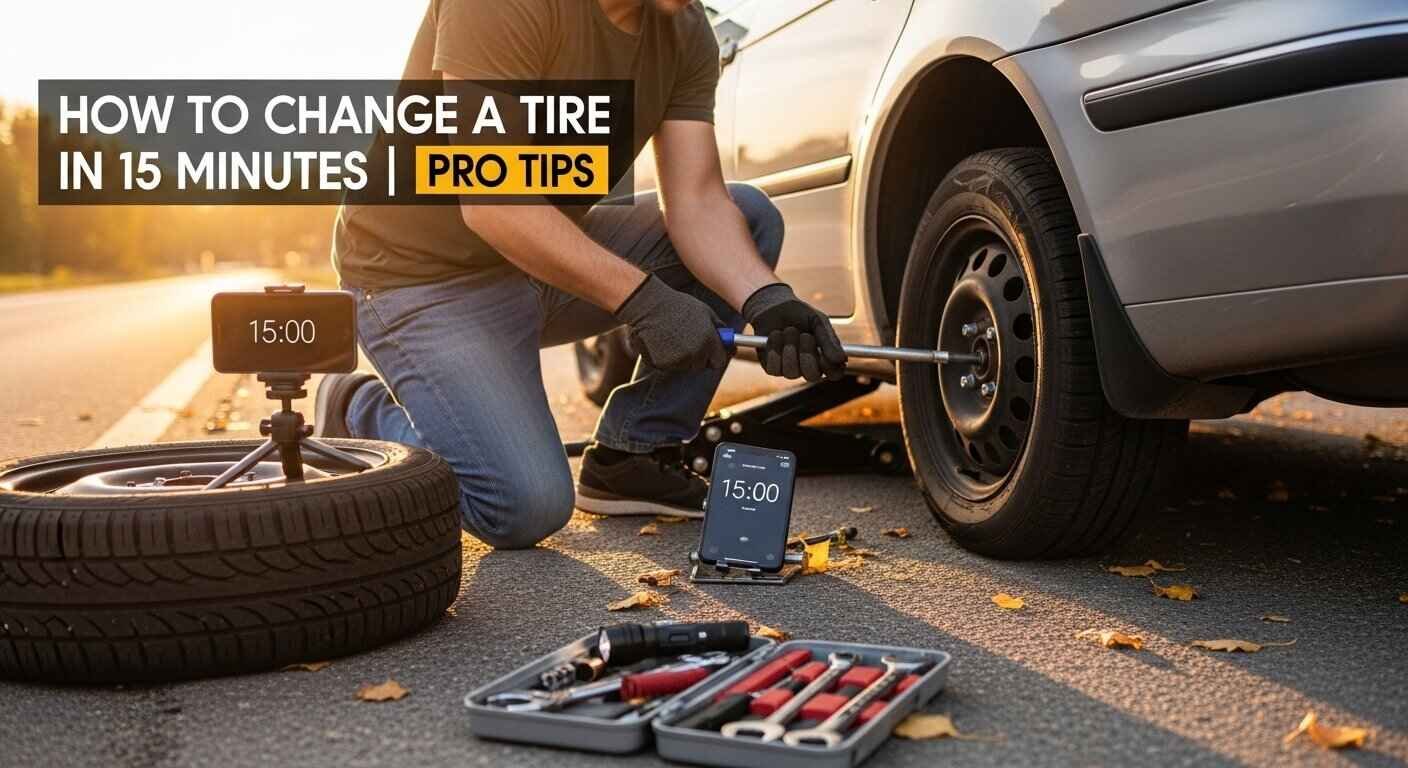
For someone who has changed tires before and knows their vehicle, the process typically takes 12-15 minutes from start to finish. This assumes you have all your tools ready, good lighting, and no complications.
For a complete beginner doing it for the first time, expect 30-45 minutes. This includes time to locate your tools, consult your owner’s manual, and work carefully through each step.
During an emergency with added stress, poor weather, or nighttime conditions, even experienced people might need 20-30 minutes. Don’t rush—taking your time to do it correctly and safely is more important than speed.
Factors That Affect Duration
Several things can add time to the process: rusted or over-tightened lug nuts that require extra effort, difficulty locating jack points, weather conditions making work uncomfortable, heavy traffic requiring extra safety precautions, or a lack of familiarity with your vehicle’s specific setup.
The more you practice, the faster and more confident you’ll become. Emergency responders and tire technicians can change tires in under five minutes, but they’ve done it hundreds of times.
Tire Maintenance: Preventing Flats Before They Happen
Regular Pressure Checks
Proper tire inflation is crucial for safety, fuel efficiency, and tire longevity. Check your tire pressure at least once a month and before long trips. The correct pressure is listed on a sticker inside your driver’s door jamb, not on the tire sidewall (that number is the maximum pressure, not the recommended pressure).
Under-inflated tires wear faster, reduce fuel economy, and are more prone to failure. Over-inflated tires provide a harsh ride and wear unevenly. A simple digital tire pressure gauge costs less than $10 and takes 30 seconds per tire to use.
Tread Depth Inspection
Tire tread provides traction, especially in wet conditions. To check tread depth, use the “penny test”: insert a penny into the tread groove with Lincoln’s head upside down. If you can see all of Lincoln’s head, your tread is too shallow and needs replacement.
Most tires also have wear bars—small raised sections in the grooves that become visible when the tire is worn down to 2/32 of an inch. If your tread is level with the wear bars, replace the tire immediately.
Visual Inspections
Every few weeks, walk around your vehicle and visually inspect your tires. Look for cuts, bulges, cracks, or embedded objects like nails or screws. Check the sidewalls for damage from curbs or potholes.
If you notice a bulge or bubble in the sidewall, don’t drive on that tire. This indicates internal damage and could lead to a sudden blowout. Have the vehicle towed to a tire shop.
Rotation and Alignment
Regular tire rotation (typically every 5,000-7,000 miles) ensures even wear across all four tires, extending their lifespan. Front tires usually wear faster than rear tires due to steering and extra weight from the engine.
If you notice uneven wear patterns, vibration while driving, or your vehicle pulling to one side, you may need a wheel alignment. Misalignment causes premature tire wear and can lead to sudden failure.
Understanding Tire Age and When to Replace
The 6-Year and 10-Year Rules
Even if your tire tread looks fine, tires age and degrade over time. Rubber compounds break down from UV exposure, temperature cycles, and chemical reactions. Most tire manufacturers and safety organizations follow these guidelines:
- Six Years: Have your tires inspected by a professional annually after six years of use.
- Ten Years: Replace all tires that are ten years old, regardless of appearance or tread depth. This includes your spare tire.
Finding Your Tire’s Age
Every tire has a DOT number molded into the sidewall. The last four digits indicate the week and year of manufacture. For example, “2319” means the tire was made in the 23rd week of 2019.
Check your spare tire’s age too. That spare sitting in your trunk for a decade might look perfect but could be dangerously degraded.
Frequently Asked Questions About Changing Tires
1. Can I change a tire without a jack?
Technically, yes, but it’s extremely dangerous and not recommended. Some people have used rocks, logs, or ramps to elevate their vehicle, but this is unstable and risks serious injury. If your jack is broken or missing, call for roadside assistance rather than attempting unsafe improvisation. Your safety is worth the tow fee.
2. How tight should lug nuts be?
Lug nuts should be tightened to your vehicle’s specific torque specification, usually between 80-100 foot-pounds for passenger cars. Without a torque wrench, tighten them as firmly as you can using your lug wrench and your body weight. They should be very tight, but don’t stand on the wrench or use a pipe extension—that could over-tighten them and damage the studs. After driving 25-50 miles, recheck and retighten if needed.
3. Can I drive on a spare tire for a week?
It depends on the type of spare. A full-size spare can be driven indefinitely, though you should still get your flat tire repaired or replaced soon. A donut spare (space-saver) should only be driven to the nearest tire shop—maximum 50 mph and 50-70 miles total. These compact spares aren’t designed for extended use and can damage your vehicle’s differential if driven too long.
4. What if my spare tire is also flat?
This unfortunate situation happens more often than you’d think. If your spare is flat, you have a few options: call roadside assistance for a tow to a tire shop, use a tire repair kit if you have one and the flat is repairable, or use a portable air compressor to inflate the spare enough to drive to a gas station or repair shop. This is why checking your spare tire pressure every six months is so important.
5. Is it safe to change a tire on the highway?
Changing a tire on a busy highway or interstate is dangerous and should be avoided if possible. If you absolutely must stop on a highway, pull as far onto the shoulder as possible, turn on hazard lights, and consider calling for professional assistance instead. If you decide to proceed, work quickly, stay visible, and be hyper-aware of passing traffic. Statistics show that dozens of people are killed each year while working on vehicles on highway shoulders.
6. Why do I need to use a star pattern when tightening lug nuts?
The star or criss-cross pattern ensures even pressure distribution across the wheel hub and brake rotor. If you tighten lug nuts in a circular sequence (one after another), one side of the wheel gets fully tightened before the other side, which can warp the brake rotor, create vibration, or leave some lug nuts loose. The star pattern tightens them gradually and evenly, which is crucial for safe, balanced wheel mounting.
7. Can I repair a tire myself instead of changing it?
Small punctures in the tire tread (not the sidewall) can sometimes be repaired with a tire plug kit. These kits cost about $10-15 and include rubber plugs and a reaming tool. However, this is a temporary fix. Professional tire shops use an internal patch combined with a plug, which is much more reliable. DIY plug repairs should only be done to get you safely to a tire shop, not as a permanent solution.
8. What should I do with my old tire after getting it replaced?
Never leave old tires on the roadside—it’s illegal in most jurisdictions and harmful to the environment. Tire shops will dispose of or recycle your old tire when they install a new one, usually for a small fee ($2-5). Tires can be recycled into playground surfaces, rubber mulch, or fuel. Some communities also hold periodic tire recycling events where you can drop off old tires for free.
Conclusion: Mastering This Essential Driving Skill
Changing a tire is one of those fundamental life skills that every driver should know, right alongside checking your oil or jump-starting a dead battery. While it might seem intimidating the first time, it’s actually a straightforward process that becomes second nature with practice.
The key takeaways to remember: always prioritize safety by finding a safe location and securing your vehicle properly; loosen lug nuts before raising the vehicle; use your designated jack points; tighten lug nuts in a star pattern; and treat your spare tire as a temporary solution that gets you to a tire shop, not a permanent fix.
Take 30 minutes this weekend to practice in your driveway. Familiarize yourself with your tools, locate your jack points, and go through the entire process once without pressure. When an actual flat tire happens—and statistically, it will happen to you at some point—you’ll handle it with confidence instead of panic.
Your safety and independence on the road are worth this small investment of time. Share this guide with new drivers in your family, bookmark it for future reference, and keep your spare tire properly maintained. The next time you hear that dreaded thumping sound, you’ll know exactly what to do.
Drive safe, stay prepared, and remember: you’ve got this.