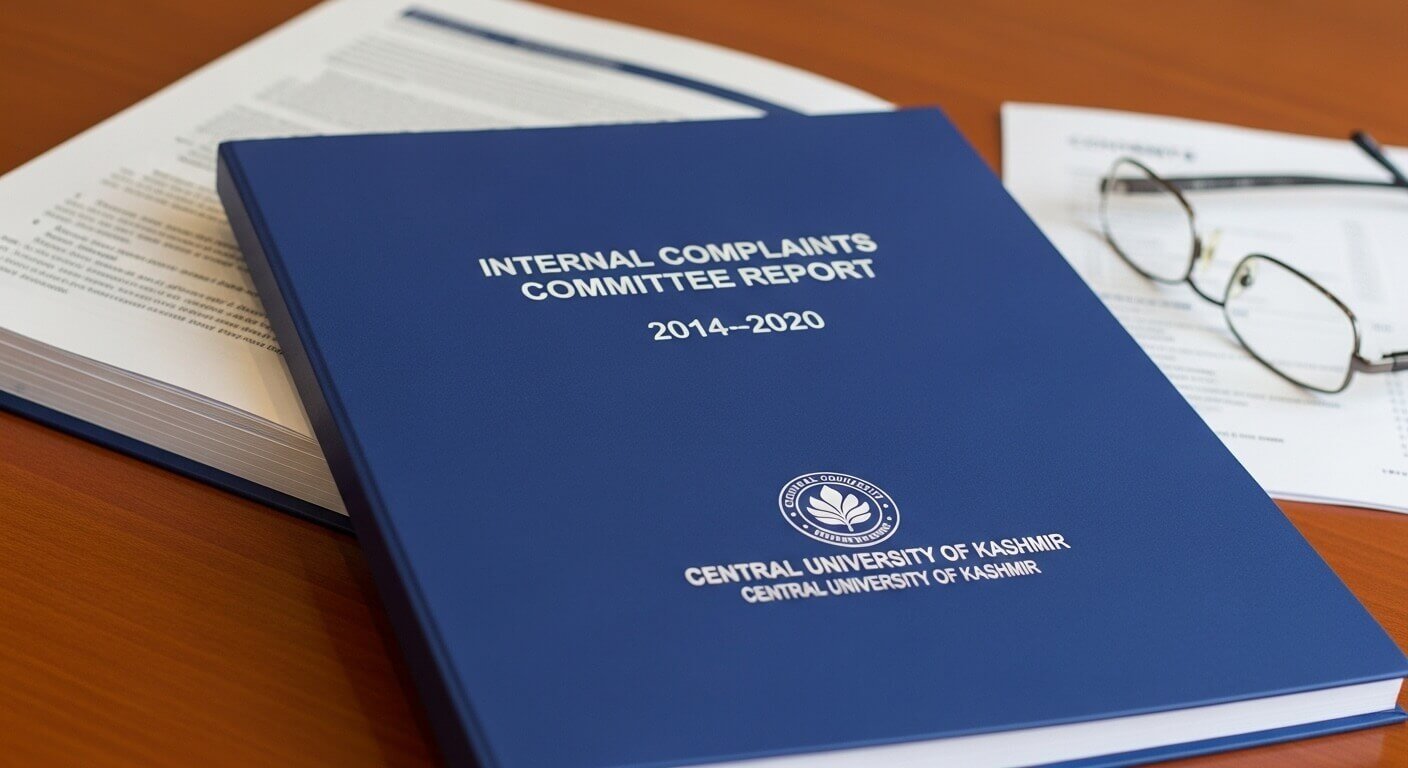
If you’ve come across the phrase “ICC report” or heard someone mention the Internal Complaints Committee at the Central University of Kashmir, you might be wondering what it all means. Maybe you’re a student, a researcher, a journalist, or just someone trying to understand how universities handle sensitive complaints.
This guide explains everything — what the ICC is, why it exists, what happened at the Central University of Kashmir between 2014 and 2020, what an ICC report actually contains, and why any of this matters for you.
What Is the Internal Complaints Committee?
Let’s start with the basics.
The Internal Complaints Committee — or ICC — is a special group inside a university or workplace. Its job is to receive and investigate complaints of sexual harassment. Think of it like a referee inside the institution: neutral, confidential, and legally empowered to investigate and recommend action.
In India, every university and every workplace with ten or more employees is legally required to have an ICC. This is not optional. It comes from a law called the Sexual Harassment of Women at Workplace (Prevention, Prohibition and Redressal) Act, 2013 — commonly known as the POSH Act.
The POSH Act itself came from a landmark 1997 Supreme Court case called Vishakha v. State of Rajasthan, where the court laid down clear guidelines on how workplaces must protect women from harassment. The POSH Act turned those guidelines into law sixteen years later.
Here’s what makes the ICC different from a general complaints box or a student welfare officer: the ICC has the powers of a civil court during an inquiry. It can summon witnesses, examine documents, and make binding recommendations to university leadership. It must complete its inquiry within 90 days. And it must maintain strict confidentiality throughout.
Why Does a University Like CUK Need an ICC?
The Central University of Kashmir, established in 2009 under the Central Universities Act, serves thousands of students, faculty members, and staff across campuses in Ganderbal district. Like any large institution, it has a responsibility to make sure everyone — especially women — feels safe, respected, and protected.
Between 2014 and 2020, the university went through a period of significant growth. It was expanding its academic programmes, increasing enrolment, and shifting from temporary accommodations in Srinagar to its campuses in Ganderbal. With that growth came the responsibility to strengthen institutional systems — including those that protect people from harassment and discrimination.
The ICC at CUK operates under the direct mandate of the POSH Act and the University Grants Commission (UGC) Regulations 2015 on Prevention, Prohibition and Redressal of Sexual Harassment of Women Employees and Students in Higher Educational Institutions. These UGC regulations specifically apply the POSH framework to universities and colleges across India.
What Does the ICC Actually Do?
Here’s how the ICC works in simple terms. Imagine you are a student at CUK and something happened to you — a professor made inappropriate comments, a classmate repeatedly sent unwanted messages, or you witnessed someone else being mistreated.
Here is what the ICC is supposed to do:
- Step 1 — Receive the Complaint. A woman (student, employee, or visitor) files a written complaint with the ICC within three months of the incident. In some cases — such as when the complainant is unable to file herself — a friend, relative, or NCW officer may file with her written consent.
- Step 2 — Attempt Conciliation (Optional). Before launching a formal inquiry, the ICC may try to resolve the matter through conciliation — a guided, structured conversation between the parties — if the complainant requests it. Importantly, no monetary settlement is allowed at this stage.
- Step 3 — Conduct a Fair Inquiry. If conciliation is not sought or does not work, the ICC opens a formal inquiry. Both the complainant and the person complained against are given equal opportunity to present their side, share evidence, and name witnesses. The committee then examines all of this carefully.
- Step 4 — Submit a Report and Recommendations. Within 90 days, the ICC submits a written report to the university administration. If harassment is found to have occurred, the ICC recommends disciplinary action — this could range from a written warning to termination, depending on the severity.
- Step 5 — Annual Reporting. Every year, the ICC submits an annual report to the university and to the UGC. This report includes: the number of complaints received, the number resolved, the number pending, and the types of awareness programmes conducted.
This annual reporting is where the “ICC report” in our topic title comes from. The Internal Complaints Committee Report covering 2014 to 2020 at the Central University of Kashmir would be a compilation of these annual reports — documenting six years of complaint activity, awareness initiatives, and institutional compliance.
What Is Actually in an ICC Report?
Most people have never seen a university ICC report. Here is what one typically contains.
- Section 1 — Committee Composition. Lists the Presiding Officer (a senior woman faculty or staff member), the committee members (at least two should be committed to women’s welfare), and the external member (from an NGO or legal background).
- Section 2 — Complaints Data. This is the most important section. It reports: How many complaints were filed during the year? How many were investigated and resolved? How many are pending? What types of complaints were reported (verbal harassment, physical harassment, cyber harassment, etc.)?
- Section 3 — Awareness and Training Activities. What workshops, seminars, orientation programmes, and gender sensitisation events the committee organised. This is the proactive side of the ICC’s work — preventing harassment before it happens.
- Section 4 — Policy and Compliance Updates. Any changes to university policy, new guidelines issued, or updates to complaint procedures.
- Section 5 — Challenges and Recommendations. Honest reflections on what isn’t working — whether that is low complaint reporting due to fear, a lack of awareness about procedures, or resource constraints — and what the institution needs to do better.
What Happened at CUK Between 2014 and 2020?
The Central University of Kashmir’s ICC was constituted under the POSH Act 2013 and the UGC 2015 Regulations. During the 2014–2020 period, the committee worked within a university that was simultaneously growing academically and still establishing its permanent infrastructure.
Several things shaped the ICC’s work during these six years:
- Institutional Expansion: CUK was adding new departments, programmes, and research centres during this time. More people on campus meant more responsibility for the ICC to reach everyone, including new students and newly appointed staff who may not have been aware of complaint mechanisms.
- Awareness Programmes: CUK’s ICC, consistent with its mandate, organised seminars and awareness sessions on the POSH Act, the complaint process, and gender sensitivity. These were directed at both students and staff.
- Expert Engagements: The committee invited legal and academic experts — including those from national law universities — to conduct lectures on the prevention and redressal of sexual harassment. This helped build institutional knowledge and created a culture where ICC’s work was understood and not just a bureaucratic requirement.
- Proactive to Reactive Shift: A significant development over this period was the ICC evolving from being purely a reactive body (waiting for complaints) to a proactive one (running awareness campaigns, advising on policy, helping shape a respectful campus culture).
- Challenges Acknowledged: Like most university ICCs in India, CUK’s committee faced the common challenge of underreporting. Many people — especially students — are not aware of the complaint process or feel hesitant to come forward due to fear of stigma or retaliation. This is a national challenge, not unique to any one institution.
Why Underreporting Is a Real Problem
One of the most important things to understand about any ICC report — including the one for CUK — is that the number of complaints filed does NOT equal the number of incidents that occurred.
Studies on workplace harassment in Indian institutions consistently show that most people who experience harassment never report it. The reasons are well-documented: fear of not being believed, concern about career consequences, not knowing how to file a complaint, social pressure, and lack of trust in the process.
This is exactly why the awareness and education side of the ICC’s work matters so much. A campus where everyone — every first-year student, every new faculty member — knows their rights and knows how to access the complaint process is a campus where the ICC can actually do its job.
The ICC report for 2014–2020 at CUK must be read with this context in mind. A low number of complaints does not necessarily mean a harassment-free campus. It may reflect the awareness gap that the committee was working to close during that period.
How to File a Complaint With a University ICC
For anyone reading this who may need to know: here is how the process works at Indian universities.
You write a complaint and submit it to the Presiding Officer of the ICC. You have three months from the date of the incident to file. If you are unable to file yourself, someone else can do so with your written permission.
You do not need a lawyer. You do not need to have “proof” in hand before filing — the inquiry process is precisely where evidence is examined. The ICC is bound by confidentiality: your identity and the details of your complaint cannot be shared with anyone outside the process without your consent.
If you feel that the university ICC has not handled your complaint properly, you can approach the National Commission for Women (NCW) or use the central government’s SHe-Box portal (she-box.gov.in), which sends complaints directly to the relevant institutional authority.
How UGC Regulations Strengthen the ICC Framework
The 2015 UGC Regulations went beyond the POSH Act to add university-specific requirements. Under these regulations:
Universities must display the ICC’s contact information prominently across campus — in hostels, departments, and online. They must conduct mandatory orientation for new students and staff on the complaint process. They must include ICC-related information in their prospectus and website. And they must submit annual compliance reports to the UGC.
These regulations created a much more structured accountability framework for universities than existed before 2015. For CUK, the period between 2015 and 2020 would have been one of aligning institutional practice with these enhanced requirements.
Why the 2014–2020 ICC Report Matters Today
Looking back at a six-year institutional record is not an exercise in nostalgia. It matters for several concrete reasons.
- Accountability: Reviewing what was reported, how it was handled, and what the outcomes were tells us whether the university’s systems worked fairly.
- Learning: Patterns in complaint data — types of harassment, who was involved, how long resolution took — reveal where institutions need to improve.
- Policy: ICC report findings often directly inform changes to university policy. A report showing repeated incidents in a specific department or campus area would prompt targeted interventions.
- Trust: When universities publish ICC reports transparently and act on their findings, it builds trust among students and staff that the institution takes their safety seriously.
For researchers, journalists, and policy analysts studying campus safety in Jammu and Kashmir — or in Indian central universities more broadly — the 2014–2020 ICC record at Central University of Kashmir is a valuable case study in how a growing institution built its accountability infrastructure from the ground up.
Frequently Asked Questions
What is the full name of the ICC at Central University of Kashmir?
It is formally called the Internal Complaints Committee (ICC) of the Central University of Kashmir, constituted under the Sexual Harassment of Women at Workplace (Prevention, Prohibition and Redressal) Act, 2013 and the UGC Regulations 2015.
Where can I find the actual ICC report from CUK for 2014–2020?
Official ICC reports are typically published on the university’s website or available through an RTI (Right to Information) application to CUK’s public information officer. The CUK website at cukashmir.ac.in is the starting point.
What is the POSH Act, and does it apply to students?
Yes. The POSH Act, 2013, applies to workplaces, and universities are classified as workplaces. The 2015 UGC Regulations explicitly extended its protections to students enrolled in higher educational institutions, not just employees.
Can a male student or staff member use the ICC?
The POSH Act specifically covers women. However, universities may have separate grievance mechanisms for harassment complaints from male students or staff. It is worth checking CUK’s official grievance policy for details.
What happens if the ICC does not act on a complaint fairly?
If the ICC fails to act properly, the complainant can escalate to the National Commission for Women (NCW), file a complaint on the She-Box portal, or approach the courts. Non-compliance by institutions can attract penalties under the POSH Act, including fines.
Is the ICC report the same as an NAAC report?
No. The ICC report is specific to complaints and gender safety. A NAAC (National Assessment and Accreditation Council) report is a broader institutional quality assessment. They are separate documents with different purposes.
Final Thought
The Internal Complaints Committee report covering 2014 to 2020 at the Central University of Kashmir represents something more than a bureaucratic record. It reflects six years of institutional commitment — imperfect, evolving, and real — to building a campus where harassment is taken seriously, where people know their rights, and where those in authority are held accountable.
Understanding what the ICC does, what the law requires, and how to access these protections is not just for researchers. It’s knowledge that every student and staff member deserves to have.